
When generative AI can produce plausible essays in seconds, higher education faces a defining question: How do universities ensure students are still doing the thinking?
This blog was kindly authored by Isabelle Bambury, Managing Director UK and Europe at Studiosity, a GuildHE Partner. Register for our specialised session online on 12 October (2pm - 2.45pm) to explore more.
For specialist and smaller-scale institutions across the GuildHE network, degree value has always rested on distinctive, high-touch learning environments, critical thinking, and genuine student capability. Yet, as AI tools become ubiquitous, institutions find themselves caught between two pressing risks: an infrastructure challenge (obsolete, high-friction detection tools) and a pedagogical challenge (cognitive offloading, where AI removes the friction vital to deep learning).
To address both challenges, long-standing GuildHE member Plymouth Marjon University – a Studiosity partner since 2018 – is moving beyond reactive models to implement a proactive, technology-enabled framework by adopting Studiosity’s Support and Validate model.
By shifting the narrative from surveillance to student agency, Plymouth Marjon is demonstrating how institutions can adapt to AI while keeping human learning at the absolute centre.
The Problem: The Pitfalls of ‘Police and Punish’
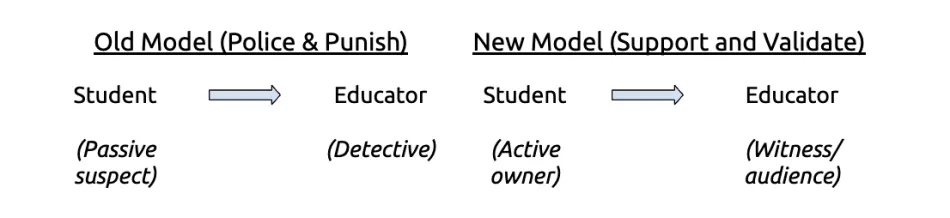
When generative AI first disrupted assessment design, much of the higher education sector defaulted to a ‘Police and Punish’ mindset. Institutions relied heavily on summative AI detection scores to flag potential misconduct.
However, this legacy approach created significant strain for both staff and students:
- For educators: Vague percentage scores led to severe ‘detective fatigue.’ Academics were forced to spend hours investigating ambiguous probability scores, searching for signs of non-human writing rather than teaching.
- For students: According to Studiosity/YouGov 2026 UK Wellbeing Research, 75% of students are now stressed about being wrongly flagged by detection tools - a fear that directly impacts their sense of belonging and academic persistence. Rather than feeling supported in their academic growth, students are placed under constant, unwarranted suspicion.
- For pedagogy: Summative detection happens after the work is submitted - far too late to support learning. Generic AI tools encourage cognitive offloading, where AI does the heavy lifting and students miss out on essential skill development.
Learning is a human act of thinking, not simply the file a student hands in. Real learning requires the ‘useful struggle’ - the productive friction of drafting, structuring, and critical reflection where degree value actually lives.
Isabelle Bambury, Managing Director UK and Europe at Studiosity
The Solution: Moving to Support and Validate
To solve both the pedagogical and infrastructure problems, in 2026 Plymouth Marjon University renewed its commitment through a new three-year partnership with Studiosity spanning both Support and Validate services.
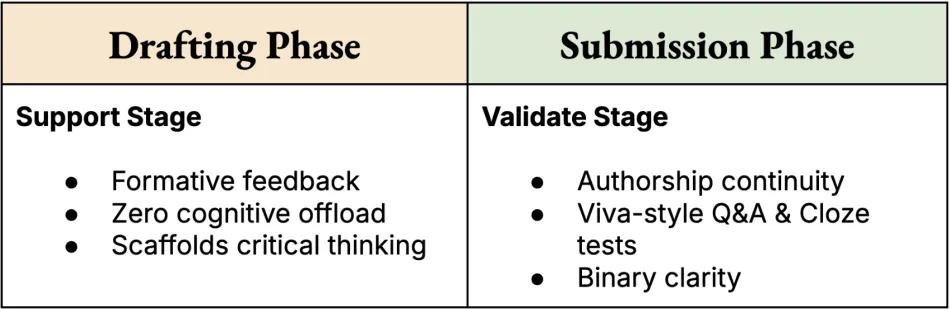
Instead of treating students as passive suspects under surveillance, this next-generation assessment infrastructure transforms students into active owners of their own learning journey. The model operates on two simple, connected stages: Support during drafting, and Validate at submission.
1. Support: Building Critical Thinking During Drafting
Before any work is submitted, students receive instant, formative feedback on their writing through Studiosity. Crucially, this feedback operates on a principle of zero cognitive offload. Studiosity does not rewrite student drafts or provide direct answers. Instead, it offers pedagogical scaffolding that prompts students to refine their arguments, improve structure, and deepen critical analysis.
Students build confidence in their voice while they draft, ensuring that their human effort remains intact.
2. Validate: Empowering Student-Led Authorship
When it comes time to submit an assessment, students are given the opportunity to stand up for their own learning and self-validate their work. Rather than relying on a black-box AI score, the platform uses multi-faceted, student-led validation mechanisms:
- Authorship continuity: Students match their writing against a previously submitted writing sample, growing and demonstrating their evolving academic voice over time.
- Viva-style Q&A: Students answer personalised, reflective questions about the logic, choices, and concepts within their specific submission.
- Cloze tests (fill-in-the-blanks): Backed by research showing that authors have high word recall for their own original work, these short exercises provide defensible proof of effort.
Through this process, the student becomes the actor demonstrating their thinking, and the educator becomes the receptive audience.
The Core Pillars Driving Success at Plymouth Marjon
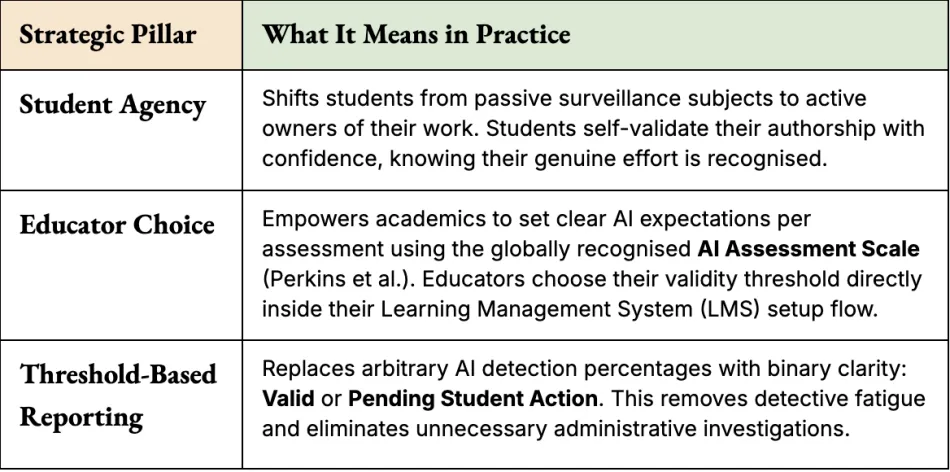
The implementation at Plymouth Marjon relies on three core strategic pillars designed to preserve academic standards while lightening administrative burdens:
Restoring the Student-Educator Relationship
Perhaps the most significant impact of this model is the restoration of trust. When institutions rely on surveillance, teacher and student end up on opposite sides of a desk. By providing student-led validation infrastructure, Studiosity and Plymouth Marjon put teacher and student back on the same team.
Educators set the standard for AI use in your assessment, and your students show the thinking behind their own work – without the detective work and without new workload. Teacher and student, on the same side again.
Isabelle Bambury, Managing Director UK and Europe at Studiosity
Key Best-Practice Takeaways for GuildHE Members
For specialist HE institutions where practical, high-quality, and industry-relevant education is paramount, maintaining degree credibility is essential. Plymouth Marjon’s adoption of Support and Validate offers several key takeaways for the broader GuildHE community:
- Focus on capability, not dependence: Providing generic AI access without learning infrastructure creates dependency and risks undermining graduate outcomes. Assessment infrastructure must protect human capability.
- Move from detecting lies to verifying effort: Summative plagiarism tools are a dead end in the generative AI era. Focus on building student agency throughout the writing process, so students prove their authorship before crossing the finish line.
- Agility without burden: Implementing clear validation thresholds allows institutions to flexibly adapt their assessment security to different module needs without increasing academic workloads.
Conclusion: Protecting the future of learning
Degrees do not rest on the digital file a student hands in; they rest on visible evidence of human learning. As AI capabilities continue to evolve rapidly, higher education institutions must provide technology infrastructure that protects the integrity of the learning journey.
By partnering with Studiosity and adopting Support and Validate, Plymouth Marjon University has shown that universities do not need to choose between embracing the future and protecting academic rigour.
Register for our specialised session with Studiosity online on 12 October (2pm - 2.45pm) to find out more about how this support could support your institution.
Studiosity is writing feedback and assessment assurance to support students and validate learning outcomes at hundreds of universities across five continents, with research-backed evidence of impact. When AI can give all the answers, Studiosity is how universities make sure students are still doing the thinking. www.studiosity.com